
Thinking Beyond the Touchless Ceiling: Why AP Automation Must Learn from Exceptions
Most AP automation platforms perform well… when everything goes to plan, that is. A clean invoice arrives with all details correct, the system processes it automatically, and moves on.
But there’s a critical problem everyone operating within or adjacent to AP knows: not every invoice is clean or predictable.
Once exceptions appear, many automation platforms have the same process. Route the invoice to a human for manual resolution, and continue as normal. This could be for issues as simple as a missing PO number or incomplete coding information. The exception is handled in the moment, yes, but nothing actually changes about the AP automation process. What happens when the same issue appears again? The next invoice will be right back in the human approval queue.
This creates a familiar challenge. Touchless rates improve initially, but then you hit the touchless plateau. Most invoices will flow through the automation queue. But that last percentage remains in a manual approval loop, with AP teams wondering why they’re seeing diminishing returns despite their optimization efforts. Around two-thirds of AP teams still waste time on manual data entry despite automation solutions, and 63% still spend upwards of 10 hours processing invoices.
The good news is that there is a better way. The touchless ceiling isn’t a configuration problem or an operational one. It lies in the system architecture itself.
What’s needed is AP automation that doesn’t simply repeat the routine tasks, but which can learn from the exceptions, too, conquering the touchless ceiling and moving towards full invoice automation. This architectural shift is exactly what Steve Standring, Fractional CRO, and Jasna Janjic, Solutions Architect, explored in our latest webinar with SSON, and here’s the key takeaways if you couldn’t make it live.
Why traditional AP automation stops learning
Here’s the issue: most automation was never built to learn. When an invoice falls outside the predefined rules, human intervention is treated as a disconnected event, not reusable intelligence. The reasoning behind the AI’s decision-making is never recorded. Automation is present, but it’s not always auditable.
This is why many companies find themselves stuck with a touchless range of 60-80%. The real limitation lies with the underlying architecture that cannot learn from those exceptions. It’s time the conversation moved beyond simple automation coverage — and toward true automation learning capability.
Rob’s no-PO, no-pay story gave us a perfect example of this failure in action. Victoria Slowikowska took it further: the governance frameworks most AP teams are building obsess over what the AI did and ignore what it should have done instead. She highlighted three recurring issues:
- Controls bolted on top of agents
- Monitoring added after go-live
- Policy exceptions – where human judgement was critical – only surfacing after the damage is done
More AI in your AP process isn't the answer
A clear theme came through in the webinar: there’s a difference between simply handling exceptions and actually learning from them in an auditable way.
Springtime’s approach starts with the idea that decisions should not remain manual forever. Instead, the patterns among exceptions should be identified, then translated into deterministic policies that can be applied consistently to future exceptions.
Jasna demonstrated this using Invoicetrack across a variety of scenarios, from PO matching and payment validation to more complex cases like withholding tax determination.
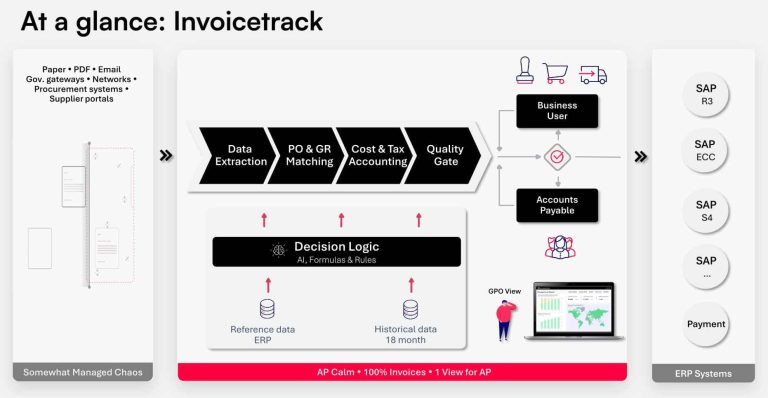
But let’s take a step back to understand what is really happening in these scenarios.
Understanding AI matching in AP Automation
There are three levels of AI matching in AP automation:
- Level 1: Intelligent Matching: The “traditional” matching, where clear failures occur, like missing PO numbers. AI can now solve these cleanly and routinely, eliminating roughly 30-40% of manual exceptions.
- Level 2: Agentic AI for Specific Use Cases: Agents take over complex cases. However, they do not always scale well, and token use can quickly add up. Agents also can tell you what they did, but often not why they did it, becoming a cost and auditability problem.
- Level 3: Reporting and Processing Mining: Once companies reach 80% touchless, gaining visibility into that last 20% is essential for improvement, yet most AP automation has no support for this function.
The issue is that most AP automation is still stuck at Level 1. It matches more than it used to, and supports higher levels of straight-through processing. But it does not fully address the touchless ceiling.
Turning human decisions into accountable automation logic
Agentic AI can then do much to push through that gap, typically landing at 80% automation. But it cannot become a replacement for governance.
As Steve explained in the session, many companies are rushing to deploy agentic AI. They’re useful for analyzing data and the pattern recognition needed to push through the touchless plateau. However, there’s the cost and auditability problem. AP is a legal process, and must have auditability built in. There’s also the issue of scale at enterprise levels.
With Invoicetrack, Springtime takes a different approach, using agentic AI to build policies based on historical data, then execute them with fast, auditable machine code. Policies are not just documentation — they become executable rules inside the system.
As Steve noted, “Agents don’t scale. Policies do.”
Automated decisions cannot simply be correct. They must also be traceable. Finance teams need to know what happened, why it happened, and which policy was applied.
The value is that Invoicetrack’s accountable AI can explain the reasoning behind a determination or recommendation. AI outputs can be reviewed and corrected, then fed back into the model’s learning as a rule to handle future exceptions. This creates a fast, repeatable, and above all, auditable process that breaks through the touchless ceiling.
It addresses the architectural failing that inevitably plateaus touchless rates. Patterns are identified and operationalized for continuous improvement, not static performance. With time, fewer and fewer exceptions require human intervention. Rather than relying entirely on manual configuration, organizations can build automation on top of existing operational knowledge.
This also highlights another lesson from the webinar: the goal is not “more AI,” it’s smarter automation that does more.
The final step: establishing visibility
The last element needed to truly address the touchless ceiling is improved visibility. Identifying what is successfully automated, and what still requires manual input or the AP team’s time. That visibility again allows for continuous improvement, be it automatically stopping problematic invoice types, or creating templates and rules to better handle them.
Integrated reporting tools, like Springtime’s Beachwalk, support this final stage. With Beachwalk specifically, you can also track KPIs and compare your touchless rate to Springtime’s best-in-class customers, by country, offering meaningful targets for future automation improvement.
Redefining automation in AP for a truly touchless future
Automation in AP has had a bumpy journey, and many companies responded, as Steve noted, by “parking AP in low-cost arbitrage centers and moving on.”
But the technology has moved on, too, and AP automation that can move past touchless ceilings is now possible – if system architecture flaw that prevents systems from capturing exception logic is addressed.
Springtime views AP as the “engine room” of the source-to-pay process, not merely a simple invoice-processing task. Implemented well, AP automation offers upstream benefits beyond conquering the touchless ceiling, too:
- Improved vendor master data quality by identifying duplicates and inconsistencies
- Better contract compliance by surfacing unenforced terms or discounts
- Enhanced data capture from invoice footers that OCR misses
- Individualized vendor management adapted to the supplier relationship
- Fraud and duplicate reduction through smarter understanding of handled invoices
- Improved supplier analytics and richer data
For AP leaders looking to their next automation investment, the question is no longer, “how many invoices can the platform process automatically today?”
Instead, it’s about how effectively the platform learns and governs to improve tomorrow.
To explore these ideas in more detail, watch the full Springtime webinar, and see exactly how adaptive AP automation is not only changing the conversation around touchless processing but also shifting the value in how AP automation works.
Or reach out to the our team directly to discuss your specific needs.